🗺️ Mastering the Art of Planning an Extended Multi-Destination Trip
Planning a trip, especially an extended journey with multiple stops, can feel daunting. There are endless questions to answer: where to go, when to go, how to get around, what to see/do, what to eat, and what to pack. When you add the opinions of travel companions to the mix, the complexity grows.
Through my travels, including a three-month trip around the world and numerous road trips across the US and Europe, I have refined a system that turns this chaos into a manageable (and enjoyable) process. Here is how I approach planning the "big" trips.
💼 Understand Your Travel Style
I am a planner. While some travelers find joy in "winging it," that approach does not work for my life or my travels. If you are a natural wanderer, adding a bit of structure to your trip ensures you do not miss the highlights of a destination.
I also have a clear perspective on the role I play in the journey. Some people are content to take the back seat, letting partners or friends drive the itinerary. My preference is to be involved. I almost always have an opinion on our travel plans, including accommodations, must-see sites, attractions, and meals. The only exception is when I visit a friend in their hometown, I happily let them lead the way.
When travel planning, balance is key. I tend to over-plan, so I have to remind myself that travel is about the journey as much as it is about the destination. Some of the most memorable moments are the ones you never saw coming. Remember to keep space open in the itinerary for those unexpected adventures.
📔 Curating the Shared Travel Bucket List
Our "shared travel bucket list" is a living document that has evolved alongside our relationship. We developed this shared list when we started dating twenty years ago, merging our individual wanderlust lists, and continuing to update and maintain it periodically.
As we meet other travelers and hear their stories, we add those recommendations to the list. When it is time to plan a new adventure, we refer to this collection to decide where to head next, aiming for several new destinations each year.
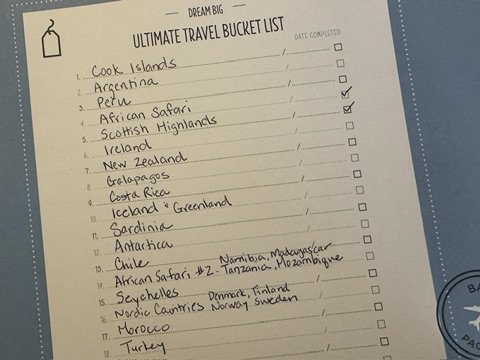
Our Current Shared Travel Bucket List
The decision of where to go is often a blend of desire and reality. While we usually start with a specific location in mind, sometimes the travel timeframe is the primary constraint. You might find yourself with a set window for travel, such as a week in October or a month in the summer. In those cases, we review our list to determine which of our bucket list destinations is at its best during that specific month. Whether you choose based on destination or a calendar gap, a curated list makes the decision easier.
📅 The Logistics of "When"
When choosing travel destinations, the timing of your visit is just as important as the location itself to ensure you have the experience you want. Sometimes you choose a destination first and then decide when to go. Other times, the specific dates you have available will determine where you should head. Regardless of which comes first, several factors should guide your decision.
Research the Season: Look for the best time to visit based on specific activities. For example, I live in St. Petersburg, Florida. While it is a beautiful destination year-round, June through August can be incredibly hot and humid. Spring is gorgeous for the beaches, but it is also the most crowded time of year. Knowing these details for your destination allows you to choose the climate and experience that you want.
Avoid the Crowds: Understanding local holiday patterns is essential for a smooth trip. We generally try to avoid National Parks during school holidays when families flock to the trails. Similarly, much of Europe goes on holiday in August, which results in more travelers on the road and a different pace of service. Regardless of when you travel, understanding these peak times helps set your expectations. For example, when we do end up visiting National Parks during school holidays, we know ahead of time that it will be busier. We simply prepare for the crowds and remember to bring our patience along with our hiking gear.
Consider the Trade-offs: There is no single "perfect" time, only the time that is right for your priorities.
Peak Season: Offers the best weather and full access to all attractions, but comes with higher prices and large crowds.
Off-Season: Provides the lowest prices and quietest streets, but you may face unpredictable weather or closed seasonal attractions.
Shoulder Season: This is often the "sweet spot" (think spring or fall), offering a balance of pleasant weather and manageable crowds.
⏳ Calculating the Duration
When planning an extended journey, we need to look at duration through two different lenses: the time required for each destination and the overall length of the entire trip.
Destination Duration: The "Must-Do" Metric
To determine how long to stay in a specific city or region, we start with our "must-do" list. We research each location to determine the time needed to appreciate the sites without rushing. To keep our travels enjoyable and sustainable, we follow a few personal rules:
The Daily Max: We usually limit ourselves to one morning activity and one afternoon activity. This ensures we aren't exhausted by dinner.
The Buffer Day: Ideally, we add a "buffer day" to each stop. This allows for spontaneous discoveries, local wandering, or a much-needed slow morning to recharge.
Overall Trip Duration: The Grand Total
The overall length of our trip is the sum of these destination stays, plus the travel days between them. Because we have transitioned into a life with fewer schedule constraints, our travel duration is more flexible. We prioritize the time needed to truly see a place. If we are making the effort of a long-distance journey, we want to take full advantage of every mile.
If you are still balancing a professional schedule or other obligations, your duration may be fixed. In those cases, the goal is to curate your destinations to fit the days you have, rather than trying to squeeze a month of sightseeing into a single week.
💻 Creating the Master Itinerary
Planning a trip to a single destination is relatively simple. However, multi-stop journeys require logistical precision to ensure everything flows smoothly. To manage this, we rely on a "Master Itinerary" spreadsheet using Google Sheets, which is easily shareable if you are traveling with a group. This document acts as the single source of truth for the entire trip, helping to track destinations, arrival and departure dates, transit, accommodations, must-do activities, must-see sites, must-eat at restaurants, and budget.
Step-by-Step: Building Your Master Spreadsheet
If you want to build your own, here is the structure I use to keep our extended trips organized:
Map Out the Dates: Start with columns for the Arrival Date and Departure Date. You may also want to add the day of the week to help you visualize the flow of the days, where transit schedules may be different, or sites may be closed.
Number of Nights Calculation: Next, add a column for Number of Nights. If you know how to use spreadsheet formulas, use this to calculate the Departure Date, so when you make refinements, the dates will automatically adjust.
Destination: Create a column for the specific Destination (city, region).
Distance/Travel Time: Use a column for Distance or Travel Time. I use Google Maps along with flight, train, or ferry schedules to research the duration between destinations. Understanding the time needed to get from one point to the next is vital for planning your first day in a new place.
Transport: Create a column for Transport. This is critical when you are juggling various modes of transportation, such as flights, trains, ferries, or car rentals on a multi-destination trip. This may be less necessary if you are driving your own car on a road trip.
Accommodation: Use a column to capture Possible Accommodations for the destination. Once a booking is confirmed, I remove the other options and add the Booking Confirmation Number for easy reference.
Must Do, See, and Eat: These optional columns help us determine exactly how many days we want to spend in a specific location based on our interests.
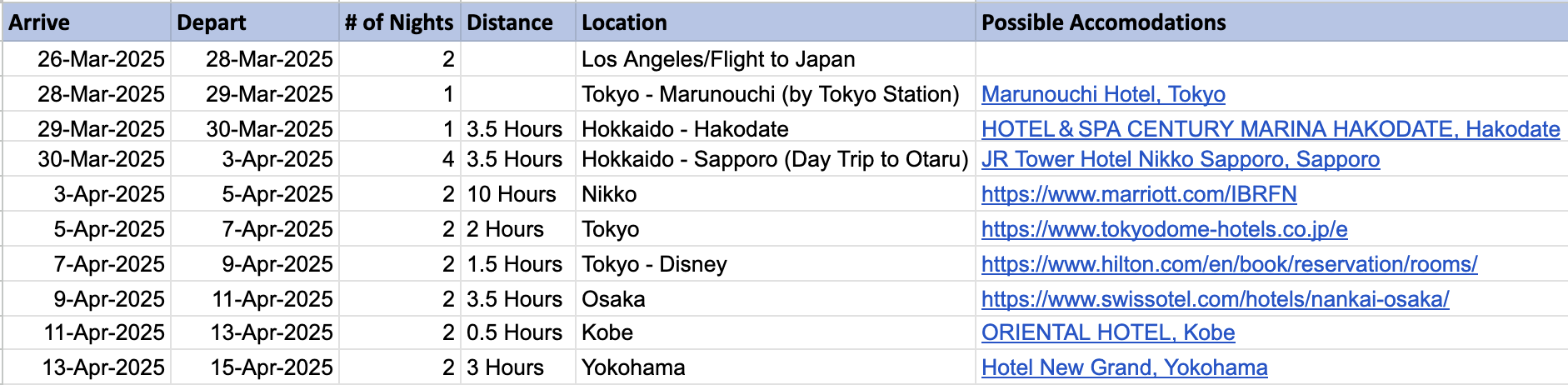
Master Planning Spreadsheet for Japan 2025 Trip
For budgeting and a day-by-day itinerary, I create separate tabs within the same spreadsheet workbook to keep everything in one file.
Digital Tools for On-the-Go Organization
While the spreadsheet is great for planning, these apps are essential while we are actually on the move. You can find my full list of essential travel apps here.
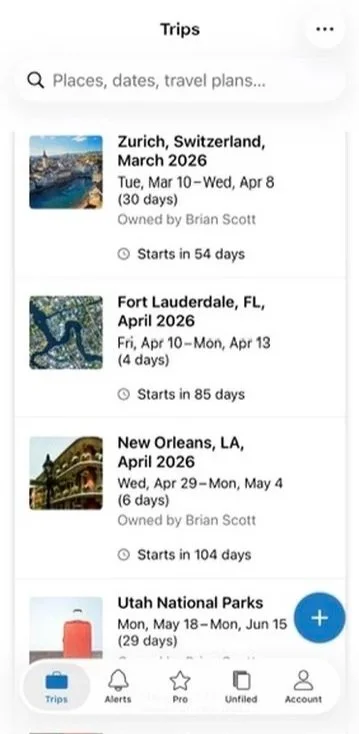
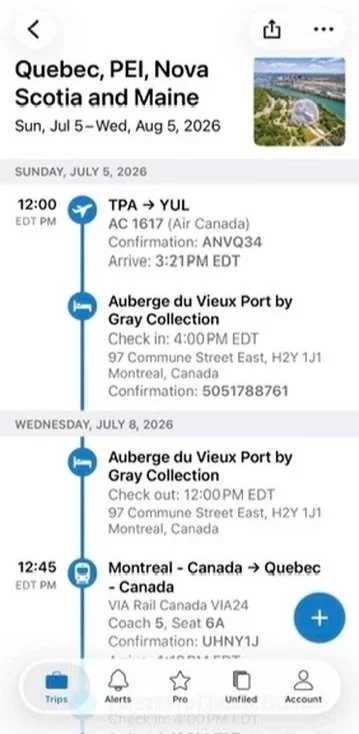
TripIt: I load every booking into TripIt, including airline tickets, accommodations, car rentals, and activities. It stores all pertinent information, such as confirmation numbers, in one place. It is excellent for identifying "gaps" in the itinerary (for example, a night without a hotel) and allows me to easily share the plan with my travel companions.
Google Maps: Beyond basic navigation, I use this to determine the feasibility of our transit. During the planning phase, I check the travel duration between destinations to decide if a journey is too long for a single day and if we need to add a stopover. Additionally, we use it to "pin" and capture the places we want to see. This provides a visual reminder when we are making bookings or when we are already on the road, looking for our next stop.
📋 Managing the Bookings
Once the master spreadsheet is structured, it is time to secure the bookings. While we typically follow a specific order (flights and transportation first), we remain flexible based on the unique needs of each journey.
Transportation
I typically book transportation first (specifically flights), followed by accommodations. However, if a specific experience is the anchor of the trip, such as a yacht charter, I secure that before the airline tickets. My process for transportation includes airline tickets, trains, ferries, and car rentals.
If you are traveling by plane, train, or ferry, research the schedules early. These services may not run every day, and prices often increase as the date approaches. In my years of travel, I have never shown up at an airport counter to buy a ticket. Even for last-minute trips, I always secure my seat via a website or app at least a few hours before departure.
Accomodations
Accommodations can make or break a travel experience. We spend significant time researching and reading reviews because the best places often book up well in advance. This is especially true at National Parks, where even the "off-season" can be surprisingly busy.
We prefer to prearrange lodging because we never want to be stuck without a place to sleep, especially after a long day of transit. Even during my earlier years of backpacking through Europe, I would book at least a few nights in advance. Today, we are quite particular about where we stay, so we prioritize securing those top-rated places as soon as the dates are set.
Preparing for the Unexpected
Missed connections, transit delays, and lost luggage are frustrating, but they don't have to ruin a trip. With the right attitude and preparation, these moments eventually become funny stories to laugh about later. To make unforeseen issues easier to handle, consider these three layers of protection:
Flexible Bookings: This applies mostly to accommodations. We prioritize refundable rates or flexible cancellation policies. Even if we have to pay a bit more upfront, the peace of mind is worth the cost if plans shift.
Travel Credit Cards: Many credit cards used for bookings offer built-in travel benefits, such as insurance for delays or cancellations. If you plan to travel frequently, having a card with these perks is incredibly beneficial.
Trip Insurance: For long-term travel, extra protection is often a wise investment. I have used providers including World Nomads and Allianz Travel Insurance in the past. While I have never had to file a claim, the security they provide for medical emergencies or major interruptions is essential for extended trips.
Pro-Tip for Groups: When traveling with friends, we find it works best for everyone to be responsible for their own transport and accommodation bookings. Once we decide on dates of travel, modes of transportation, and specific hotels, each person or couple makes their own reservation. This ensures everyone is in control of their own travel details and loyalty points. For other shared expenses while traveling, such as a taxi or group dinner or a taxi, the Splitwise app is excellent for tracking and settling up easily.
✨ The Fun Part: Researching the Experience
Once the logistics are set, the real excitement begins. This is the stage where we dive into the destination to find the must-do and must-see attractions, as well as the best places to eat.
Discovering Landmarks and Culture
We start by learning about the destination’s history, its landmarks, and its unique culture, researching everything from iconic historic sites to hidden neighborhood places and must-try local foods, marking these points of interest on Google Maps.
This visual representation is incredibly helpful. It allows us to see the locations of the places-of-interest in relation to each other and our accommodation. Seeing the "clusters" of activities helps us plan a more efficient daily flow, ensuring we spend more time enjoying the sites and less time in transit.
Securing the Must-Haves
During this research, we often find that certain popular attractions or highly-rated restaurants require advance booking. When we come across these, we make a note in our spreadsheet or go ahead and secure the reservation. Any confirmed bookings are then added to TripIt, so they are ready and waiting when we arrive.
Learning about a destination before you arrive doesn't just make the trip more efficient; it deepens the experience. When you walk through a historic district knowing the stories behind the buildings, or sit down to a meal knowing the tradition behind the dish, the journey becomes much more meaningful.
🧳 Packing Smart
When I traveled the world with a backpack, I learned the valuable lesson of "discard and acquire." I packed older items that I could get rid of along the way. This freed up space for new purchases and allowed me to adapt as I moved from colder to warmer climates.
Today, the approach has evolved. Unless we are taking our own car, we try to limit ourselves to either a travel backpack or a carry-on rolling suitcase. With the possibility of lost or delayed luggage, we prefer to keep our belongings with us. In the circumstances where we need to travel with additional luggage, such as a dive trip, we pack what we need for the first few days in our carry-on just in case something happens to the checked luggage.
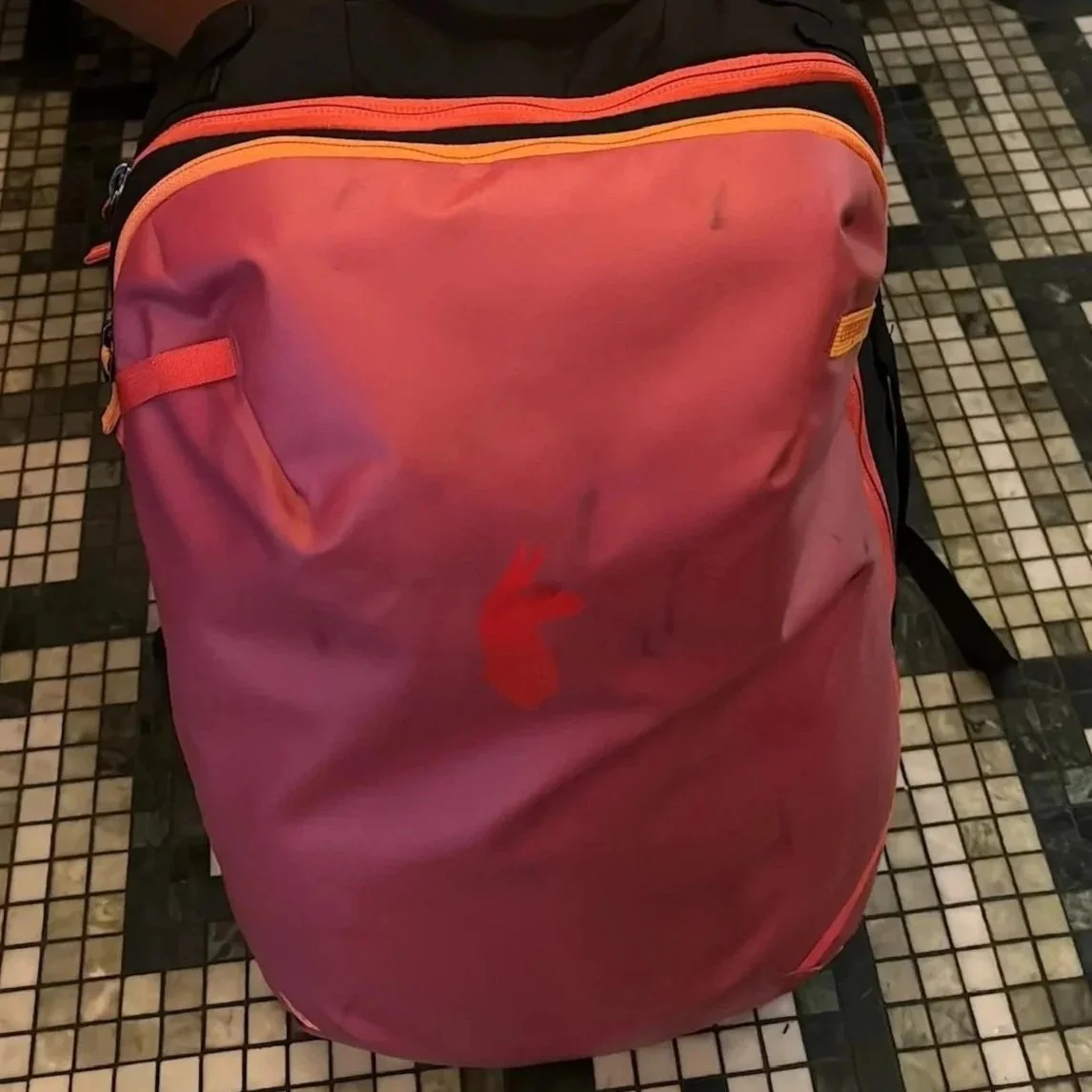
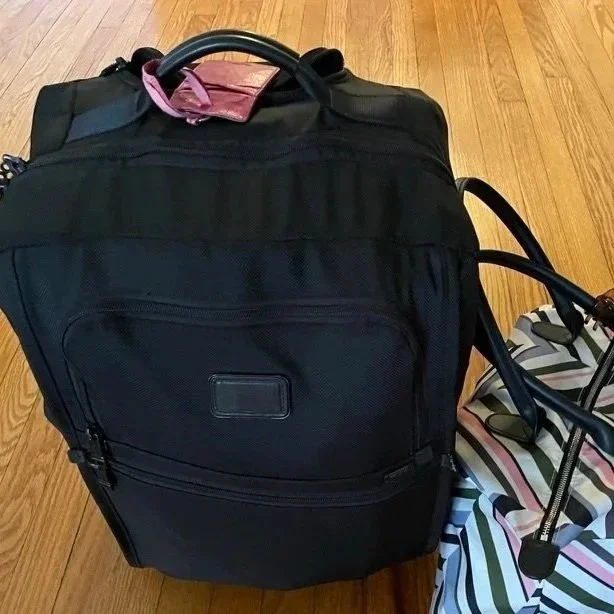
The Month-Long Strategy
Packing for a multi-week or a month in a carry-on might sound impossible, but it comes down to three principles:
The 3-to-5 Day Rule: Pack enough clothes for about three to five days. Instead of unique outfits, choose mix-and-match pieces that work together in various combinations.
Laundry on the Road: Packing light requires doing laundry during your trip. Whether using a local laundromat or a hotel service, a little planning ensures you always have fresh options without a heavy bag.
Layering for Climates: To handle diverse weather and activities, layering is essential. I pack lightweight, high-performance fabrics that provide warmth without bulk. This allows me to be prepared for a mountain hike or a city dinner using the same core items.
Staying Organized with Packr
To ensure nothing is forgotten, we rely on the Packr app. I have customized it for different trip types, from outdoor adventures to urban explorations. It even accounts for the weather forecast at my destination.
Recently, I skipped using the app for a quick overnight trip and managed to forget a couple of items. Unless you are in a very remote area or forget essential medication, it is rarely a disaster. Most things can be acquired on the road, but having a personalized digital checklist definitely provides peace of mind.
📸 Embracing the Journey
After the months of planning, research, and spreadsheet entries, the focus finally shifts from logistical planning to fully embracing the journey, exploring new places, and making those memories you have been dreaming about. While on the journey, there are a few simple habits that help you stay organized without taking you away from the moment.
Stay Connected to Your Plan
Even when you are in the flow of travel, it is important to keep your logistics close at hand. Having your plan easily accessible means you can quickly check the details and then get right back to enjoying the moment.
Reference the Master Plan: Continue to check your spreadsheet or TripIt regularly. Having your reservation details and confirmation numbers at your fingertips prevents unnecessary stress during transit or check-ins.
Organize Your Inbox: I find it helpful to create a specific folder in my email for each trip. This gives me a quick backup if I need to dig up an original receipt or ticket.
Capture the Moments
Travel is about stories, and I make an effort to document the journey as it happens.
Update the Map: We continue to save specific spots on Google Maps as we visit them. Whether it is a hidden photo spot, a charming cafe, or a standout restaurant, "pinning" these locations ensures we can reference them later and share accurate recommendations with friends.
Keep a Record: Along with taking photos and videos, I try to keep a journal or quick notes. These small details, the name of a local guide we met or the specific flavor of a dish, are the things that bring the stories to life when we return home.
A little preparation on the logistics ensures that once you arrive, you are free to truly enjoy the experience.
💬 This is the system that keeps our travel organized, but everyone has that one 'non-negotiable' they do before a big trip. What is the first thing you tackle when you decide on a new destination? Is it the flight, the hotels, or the food research? Share your travel planning tips in the comments!